JISOO YOU
SPOTLIGHT:
JISOO YOU
Jisoo You captures the totems of contemporary life—jetplanes in flight, beauty packaging, skyscrapers—rendered with precision and an acute sensitivity to light and shadow. Familiar forms take on a quiet tension, balancing the sublime with an underlying sense of unease.
Where did you grow up, and when did you know making art was something you wanted to pursue?
I was born in Seoul, grew up in Vancouver from age 10, lived in Chicago as an adult, and returned to Seoul a few years ago.
I had always known I needed to make art, simply by being aesthetically educated by works I encountered growing up, mostly online, but also in books. Mostly literature when I was younger, music and film as a teenager, and fine art later. These works taught me to want to make something as great, or greater. I thought I could make something better. I'm slightly more mellow now. I'm more interested in life.
I also ran a blog when I was 10 which were of images of Dali paintings with short introductory blurbs. But I didn't actually care too much for Dali. At the time, the idea of being well versed in surrealist paintings seemed intellectual and I chose Dali who was well known. Though, I am still interested in and influenced by Surrealism. I had also taken drawing and painting lessons from a very young age but those were more technical lessons that was beside my need to do make work. But useful. If anything I've only recently returned to oil painting as a medium after learning to work with its chemistry more deliberately.
Jisoo You:
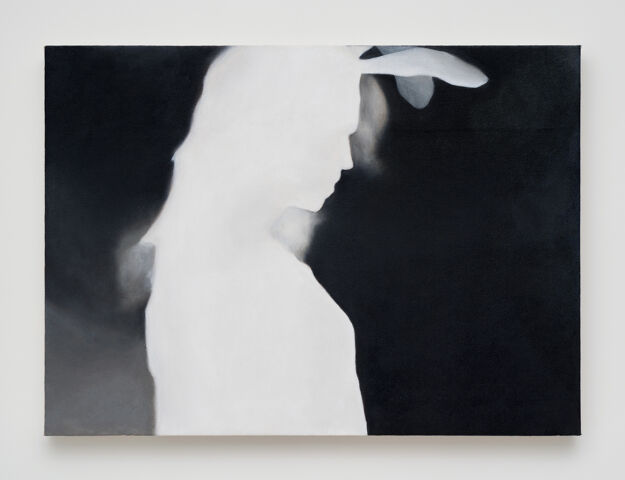
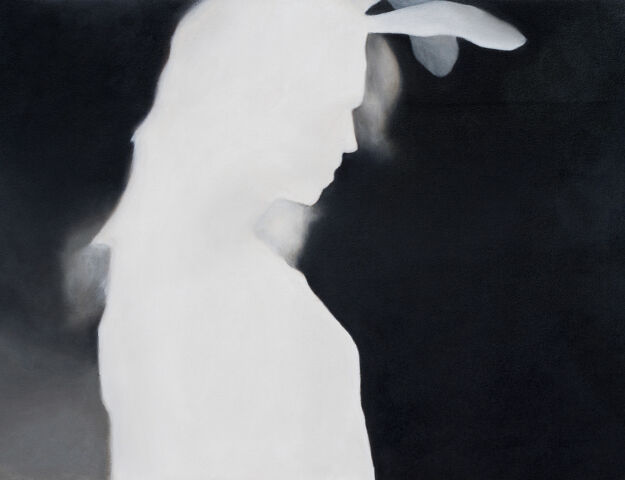
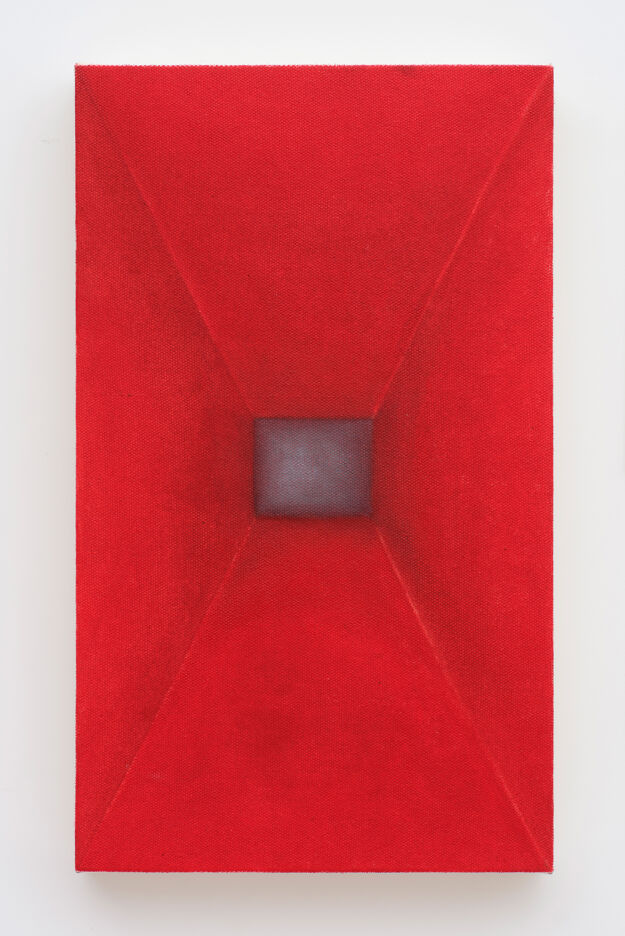
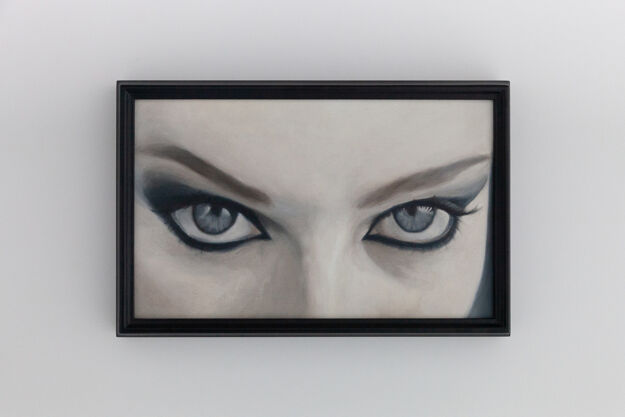
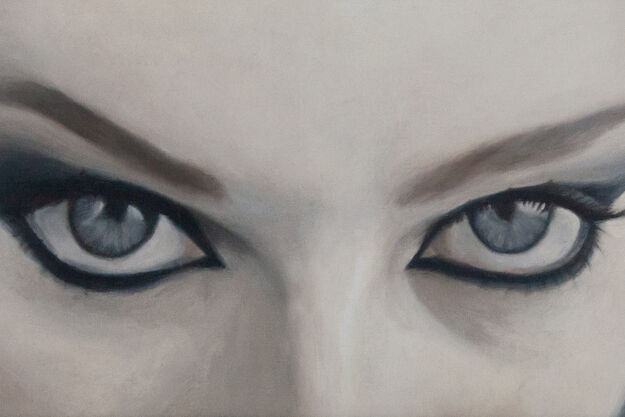
Blue Eyes, 2024
Oil on canvas
11.0 x 17.75 inches
$1,300
Buy now
Walk us through your studio practice. What does a typical working day look like for you?
I don't exactly have a studio practice per se. I find time to make work whenever possible. I spend a lot of time thinking about what to make and decide, and then sit down and work on them. I used to spend more time searching for other works to be influenced by, new or old. Sometimes I jot down ideas in my notebook and come back to them years later. Sometimes the paintings are less sufficient than how I imagined them, which then I cover up pretty often.
I had originally made more found-object sculptural works which were actually less intuitive than making a painting that, at least technically, comes easier to me. I usually have a few works going on at the same time in a different timeline. I was working on a big sculpture, titled The Thinker, for a few months until recently, which was shown together with my painting, Blue Eyes. I'm less constrained by materials, more so that the form and content of a work should inform each other.
Jisoo You:
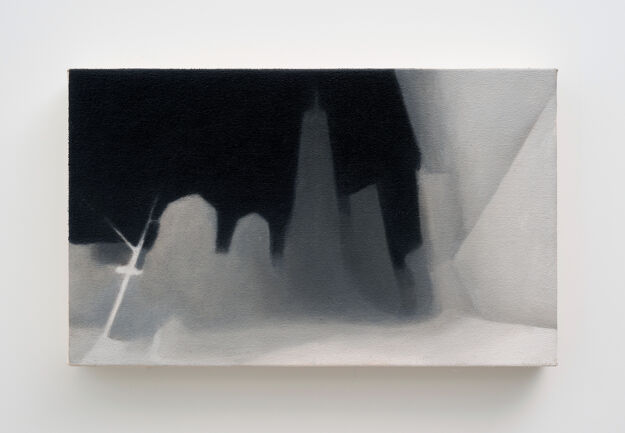
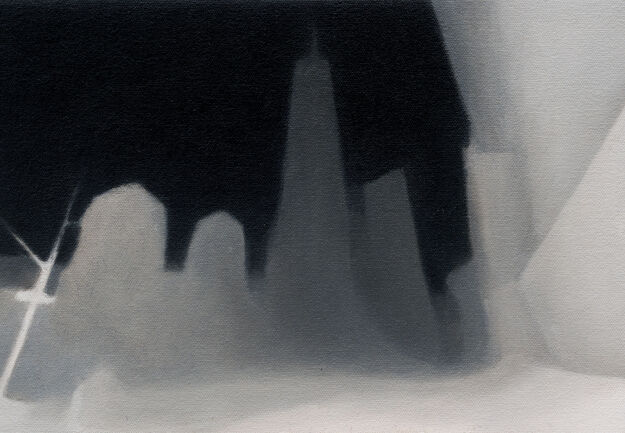
Landscape 2 (One World), 2025
Oil on canvas
8.5 x 13.75 inches
$1,000
Buy now
Where do your ideas tend to come from?
A lot of my energy is spent just living, engaging with material things, and with people. I spend a lot of time going around the city. I like to go to the mall and look at the displays. I also find campaigns and marketing interesting. All of these are productive time that informs what I make. My past experiences, family, school, my job, city life all informs my work aesthetically. But I'm not interested in using the contents of my life for the sake of self-expression. The work comes from a need I feel from the world, and from history.
I think of the things I make as expressions of the aesthetics of the barbarism of society. I am interested in culture insofar as it appears as symptom. I am interested in the material things in life. I like worldly things. I try to maintain a kind of sensitivity to the world's facades, and use the myth of reality as material, taking it both as it is and how it is imagined. The problem is that the very idea of the myth reinforced suggests at its own dissolution. My newer works are more interested in presenting these facades as less intact, more fragmented.
The works on Platform move between different tones—some are bold while others are quite soft and ghostly. How do you see the the paintings relating to each other? Are they in conversation, or do they come from separate places?
All of my works inform each other-- a lack felt in a previous work leading to the next.
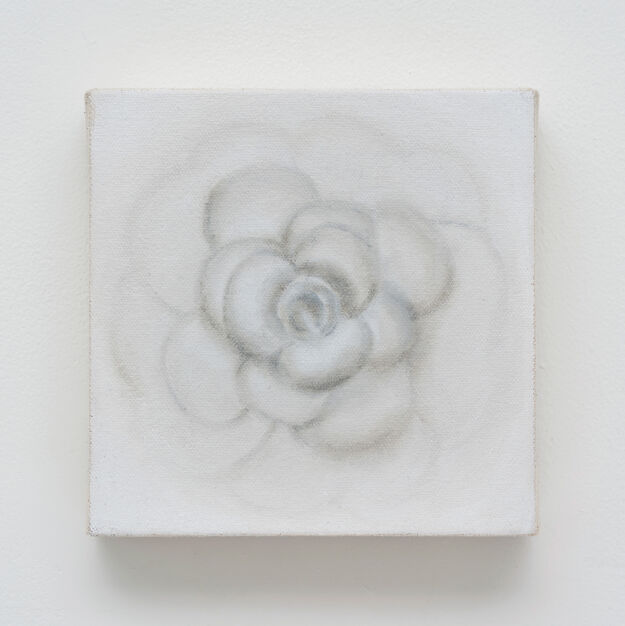
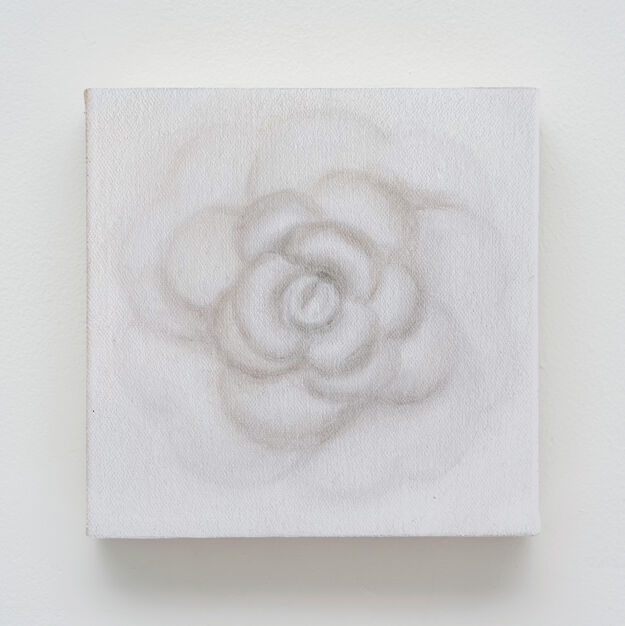
For reasons said before, and the immediacy to which I respond to what feels contemporary, I think my previous works had a tendency to have a short-lived edge. This informed my brief crisis with painting and a turn towards abstraction, away from the naturalism my work had tended toward. That's when I made the diptych painting, which began from wanting to make a trompe-l'œil of a painting frame without a clear subject.
Even so, the content of these works stems from the same sense of necessity, though it has become more a question of form.
I generally like masculine things. I like heroic art. I like works that are self-interested, coming out of a need in and of themselves. I think my bolder works state their intent more clearly, and the softer works are more withheld. I enjoy playing with this distance and the degree of definition. I could be more direct, but often prefer to be reserved when needed. It can be more effective and more seductive provided there is enough room for an initial entry. I enjoy being somewhat misunderstood. But I also think some works are softer because it was an easier way of adding a sense of illusoriness to the subjects, which I've been rethinking.
Jisoo You:
Dame, 2025 and The Double, 2025
Oil on canvas
16.1 × 9.5 inches each
$1,100 each
What's something you've been looking at a lot lately, inside or outside the art world?
I was moved by a poem I read recently by Anna Akhmatova, Everything is plundered, betrayed, sold (1921). I read it while I was hospitalized last month, and I was thinking a lot about what it takes to be truly alive. It's heroic and optimistic. When I was leaving the hospital I saw a stone plaque outside, with the phrase from the U.S. Declaration of Independence; Life, Liberty and the Pursuit of Happiness. It felt like a great coincidence and I was touched by it.
I think often about fate. I'm interested in things like physiognomy, names, and temperaments. I think of fate simply as the things you are born into and chained by, as in being born into society. You're born into your name, your face, your family, your country. Except you can change them. Perhaps physically and materially, yes, but more so change what they means to you. To love your fate. Amor fati.
I'm interested in psychoanalysis for similar reasons. It begins by taking the phenomena-- the appearance of things-- as truth, although it is a false truth. Even if you may never be cured. I approach art similarly. It may not be capable of changing reality, but it can be illuminating-- it can change how you see the world aesthetically.
Who is an artist whose practice you find yourself returning to?
I've been looking at Barnett Newman more lately. I've been wanting to visit the Rothko Chapel in Houston. He has a sculpture there. I also like Silke-Otto Knapp's paintings. Seeing her show at the Renaissance Society in Chicago was one of the moments that made me want to start painting again. Renaissance Society was one of my favorite places in Chicago. Many of the shows there had an effect on me. I also recently remembered watching this video called Jamaica, a year ago by Lara Verheijden around 2018, that had an effect on me. I was searching for the video again, but I couldn't find it.
ABOUT JISOO YOU:
Jisoo You, (b. 1999, Korea) received her BFA at the School of the Art Institute of Chicago in 2022. Recent exhibitions include Tutorial (w/ Sean Jun Yeon), Whistle, Seoul; Arabesque N.2 (w/ Daniel Zeballos), Everything, Chicago; Real World, White Noise, Seoul; A woman with a baguette. Another one., Ruschwoman, Chicago; Villa Hamilton in Seoul. She lives and works in Seoul, Korea.